In 1995, two Danish filmmakers joined together for 45 minutes to form what would be the basis for one of cinema’s most transgressive and minimalistic movements.
The two filmmakers in question, Lars von Trier and Thomas Vinterberg, collectively decided that the current state of cinema was not good enough. That the films being released were fake; illusions designed to trick the audience into thinking everything on-screen was real. But to von Trier, Vinterberg and Dogme as a whole, film wasn’t an illusion.
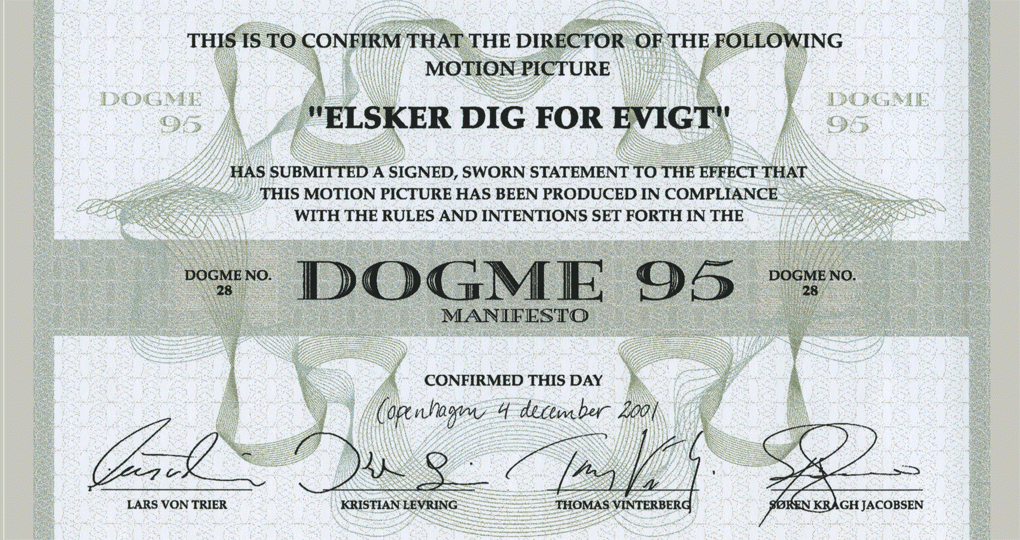
The aim of Dogme 95 was to create films that felt real; that didn’t rely on special effects, or even use artificial lighting. To achieve this sense of realism, a set of rules were established, known as ‘The Vow of Chastity’. These rules laid the groundwork for the 35 films made under the Dogme 95 moniker. A few of the rules the vow laid out was that all films must all be shot on location with no use of sets; all props must be available at the location. The sound must always be a part of the scene; no music unless it occurs in the scene. And the film must take place in the here and now, meaning the story cannot take place in the past or future and it must be filmed where the filmmaker is based.
These elements helped to create a series of films that felt real, whilst also looking incredibly low-budget and quite amateurish. Nowhere is this more prevalent than with Lars von Trier’s Idioterne, known in English as The Idiots.

The film details the life of a commune of deeply troubled people, who act as though they are developmentaly disabled, as they view their behaviour as a way to detach themselves from the society they see as being as being as stupid as they act.
This film is not comfortable to watch, nor is it a visually pleasing film to watch. The contents of the film, from the way the characters behave, to the rather sudden and completely uncensored sex scene, even the crude and unsteady cinematography, are completely transgressive; something you would not find in a typical Hollywood production. It pushes the boundaries of what can and cannot be shown in film, though it can still come across as quite offensive, certainly uncomfortable.

While the intent behind Dogme is most certainly intriguing, not everyone can appreciate the films the movement has produced. The Idiots was dismissed as a joke at the Edinburgh film festival and was booed and heckled at the Cannes film festival. While the artistic motive behind Dogme can be appreciated by some, others can only loathe the unprofessional and rather offensive nature of the movement.

Dogme 95 occupies a short space in time, 10 years to be exact. By the end of the movement, Dogme had ended up becoming a genre of its own, something the movement was deeply against. And, in a way, that might be why Dogme can be so easily forgotten by most.
 Oliver Swithenbank - The Wider Screen