Jan Svankmajer is a surrealist filmmaker and animator from the Czech Republic, formerly Czechoslovakia, with a career that spans over 55 years, with all his work between 1964 and 1988 being short films.
At the start of his career, Czechoslovakia was under the Soviet Union’s control and with that came several hurdles Svankmajer had to overcome, mostly involving censorship. He was banned from making films for 8 years by the Soviet government in 1972. It was not until the ban had been lifted that Svankmajer began work on his first feature film; an adaptation of a beloved children’s story.
‘Neco z Alenky’, known simply as ‘Alice’ in English, is terrifying.

As soon as the film begins, it sets a very unsettling atmosphere. The film opens with slow, quiet shots of a running river, followed by the opening credits, which are accompanied with close-up shots of a little girl talking. This young girl, who I assume is Alice, acts as the film’s narrator and is the only voice you will hear throughout this entire experience. One of the first things she says is, “You will now see a film… made for children… perhaps”. It seems like such an odd way to start a film; there wouldn’t normally be a reason to start a film like this, but for ‘Alice’, there is a very good reason.

As the film continues, the audience will be exposed to some truly nightmarish imagery. The world of Wonderland that most people know of is bright, colourful and nonsensical, but in a charming way. This film, on the other hand, portrays Wonderland as a dark and foreboding world, filled with horrifying creatures. Svankmajer’s Wonderland is still nonsensical, seemingly more-so at times, but in a much more disturbing manner that can really get under your skin at times.
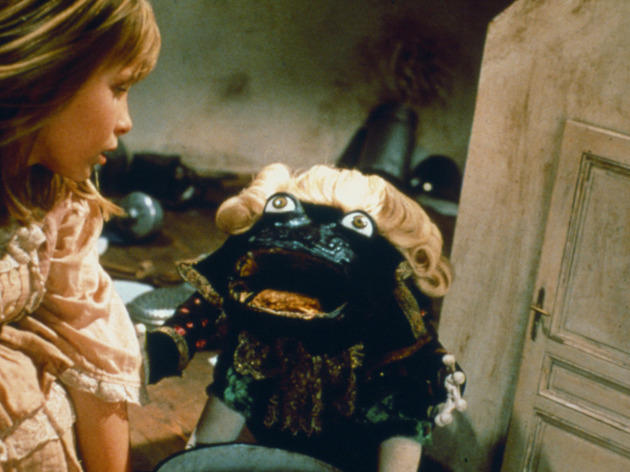
And lest it not be mentioned, the music, or more, the complete absence of it, bar the end credits. The only sounds you will be hearing in this film is the voice over and the quite unsettling sound effects. The sound of the scissors clashing is sharp and menacing and the shattering of plates, everything sounds so raw and natural, yet it still manages to create an uneasy feeling throughout the film. As for the narration, it is hard to say. The original Czech language version of the film is only available on the recent home video releases of ‘Alice’. The English version has a weird and quite laughable dub, clearly done with very little direction. Luckily, the narrator doesn’t speak that frequently, meaning very little dialogue and more time dedicated to the foreboding ambience of the film.
To classify ‘Alice’ as a children’s film would be horribly inaccurate. Most children would be scarred from watching this film. And yet, this film is still incredibly remarkable. The dolls look so natural, the scenery is decrepit and haunting, and the sound is sinister and raw. Everything about this film is so creepy, but that doesn’t stop it from being one of the most unique interpretations to one of the most beloved children’s stories ever told.

